What the Incoterms rules define
Incoterms 2020 is the latest set of 11 international trade rules published by the International Chamber of Commerce (ICC), which came into force on 1 January 2020.
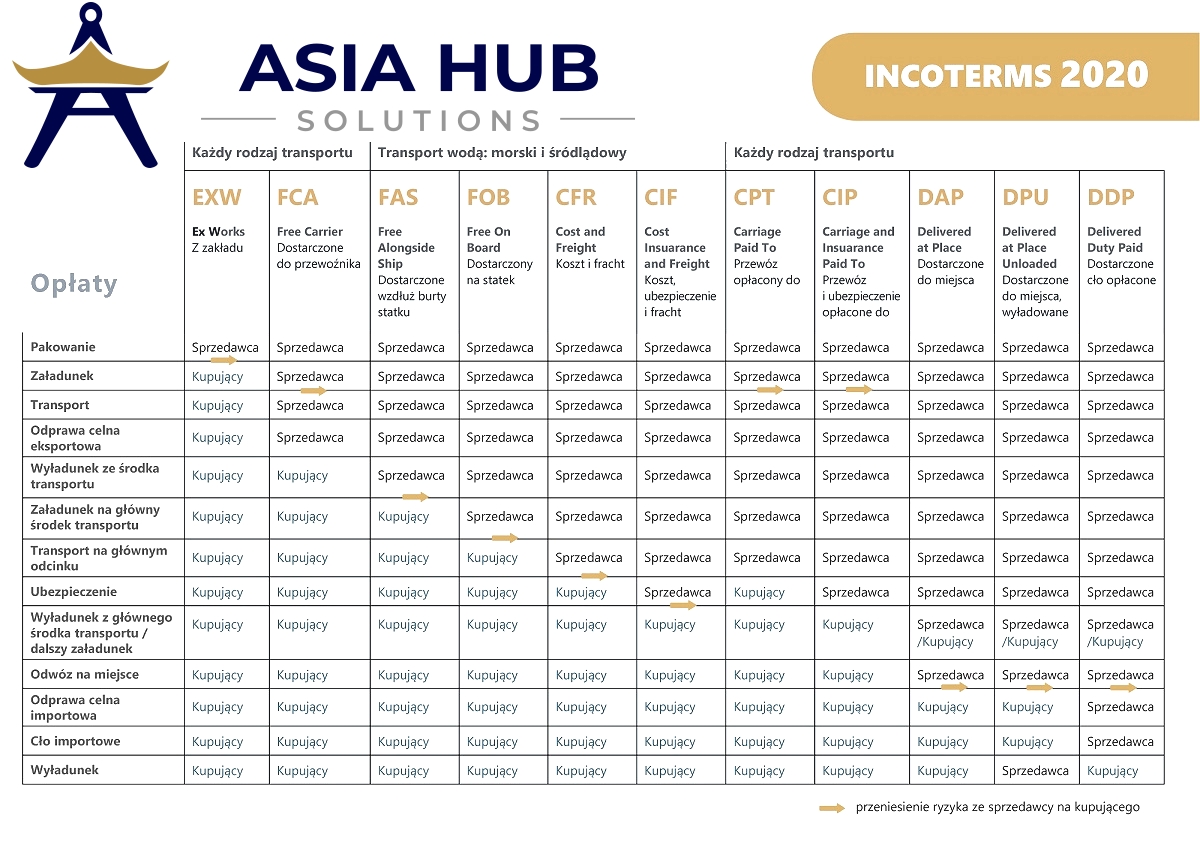
They are the standard in B2B sales contracts, precisely defining:
- Cost allocation: who pays for transport, customs duty, insurance and loading.
- Transfer of risk: the exact moment when responsibility for the goods passes from the seller to the buyer.
- Obligations of the parties: who arranges the documentation, customs clearance and insurance.
Key changes in the 2020 version
Compared with the previous version (from 2010), several significant changes were introduced:
- DAT replaced by DPU: the Delivered at Terminal rule was renamed Delivered at Place Unloaded (DPU), allowing goods to be unloaded at any agreed place, not only at a terminal.
- Different insurance levels: the CIP rule now requires the highest level of cover by default (clause A), while CIF keeps the standard level (clause C).
- FCA and the bill of lading: the parties can now agree that the buyer instructs the carrier to issue an “on board” bill of lading to the seller, which makes letter-of-credit settlements easier.
- Transport security: greater emphasis has been placed on obligations relating to transport security requirements.
- Own means of transport: the FCA, DAP, DPU and DDP rules now cover situations where the seller or buyer arranges transport with their own means, without an external carrier.
Classification of the rules
There are 11 rules, divided into two main categories depending on the mode of transport.
1. For any mode of transport (multimodal)
- EXW (Ex Works): the seller’s lowest responsibility; the buyer collects the goods from the seller’s premises.
- FCA (Free Carrier): the seller delivers the goods to the carrier nominated by the buyer.
- CPT (Carriage Paid To): the seller pays for transport to the named place, but the risk passes to the buyer when the goods are handed to the first carrier.
- CIP (Carriage and Insurance Paid To): as CPT, but the seller also pays for insurance (a high level of cover, “A”, is required).
- DAP (Delivered at Place): the seller delivers the goods to the named place, ready for unloading.
- DPU (Delivered at Place Unloaded): replaced the former DAT rule; the seller delivers and unloads the goods at the destination.
- DDP (Delivered Duty Paid): the seller’s maximum responsibility; it delivers the goods and pays import duty and taxes.
2. For sea and inland waterway transport
- FAS (Free Alongside Ship): delivery of the goods alongside the vessel in port.
- FOB (Free On Board): risk and costs pass to the buyer once the goods are loaded on board the vessel.
- CFR (Cost and Freight): the seller pays the freight to the port of destination, but the risk passes after loading on board.
- CIF (Cost, Insurance and Freight): as CFR, plus insurance (basic level of cover, “C”).
Key aspects of the rules
- Point of delivery: where the goods are physically handed over.
- Transfer of risk: the moment when responsibility for damage to or loss of the goods passes from the seller to the buyer.
- Cost allocation: who pays for transport, loading, insurance and customs clearance.
Note: Incoterms do not govern the transfer of ownership of the goods or the payment terms – these must be set out separately in the sales contract.
Diagram and overview