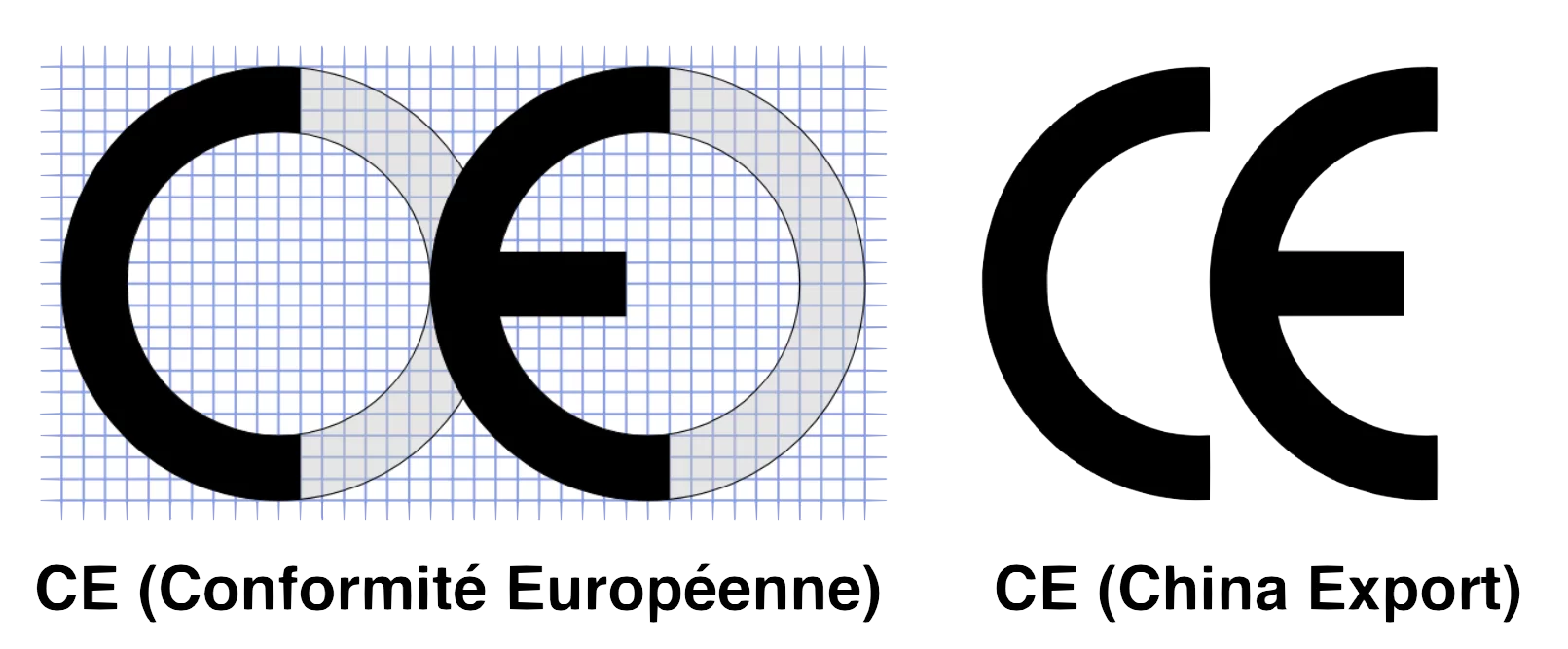
CE means legal responsibility in the EU, while “China Export” is just a print that can ruin your business.
CE – Conformité Européenne
What is it? The official marking showing that a product complies with EU requirements (safety, health, environment).
What it means in practice
- the product can legally be sold in the EU,
- it meets the relevant directives (e.g. LVD, EMC, RoHS, toys, machinery),
- responsibility always falls on the importer in the EU.
Important facts
- CE is not a certificate issued by the EU,
- it is a declaration by the manufacturer or importer, backed by documentation,
- no documents = the CE marking is invalid (even if the logo is printed).
“China Export” – what is it really?
It is NOT an official marking. It is a colloquial term for a fake CE mark used by some manufacturers in China.
What does the difference look like?
- CE (genuine): the letters C and E are clearly separated,
- “China Export”: the letters are almost joined.
And that is the only visual difference, which is why it is so easy to fall into the trap.
Why is this a real problem for the importer?
- customs and market surveillance authorities (in Poland, UOKiK) do not recognise “China Export”,
- the goods may be detained or destroyed,
- you face financial penalties and withdrawal of the product from the market,
- legal responsibility falls on you, not the factory.
What MUST you have besides the CE mark?
The print alone means nothing without the paperwork:
- EU Declaration of Conformity,
- laboratory test reports (compliant with EU standards),
- the product’s technical documentation,
- instructions and markings in the language of the country of sale.
If a supplier “sends CE for free” or “has a CE certificate for everything” — that’s a red flag.
How to protect yourself when importing from China?
- ask for test reports, not just the logo,
- check whether the tests are for THIS product, not a “similar” one,
- have sensitive products tested in an independent laboratory in the EU,
- have the full set of documents before shipment, not after.