The culture of doing business in Asia
In international trade with Asia, the hard numbers in the contract are only half of success. The other half is the ability to navigate cultural intricacies. Ignoring the Chinese concept of guanxi (relationships) or Taiwanese subtlety can cost you a contract — or even a whole supplier.
Although mainland China and Taiwan are geographically close, the differences in business culture — stemming from history and political systems — are significant.
I. Guanxi (关系): the power of relationships (mainland China)
- What it is: guanxi literally means “relationships” or “connections”. In business it is a network of mutual benefits, trust and obligations. In mainland China, business without guanxi is almost impossible.
- How it works: a Chinese partner who feels they “owe” you or are close to you will do more for you than for a stranger — faster deliveries, better prices and smoother problem-solving.
Practical tips
- Invest time: building guanxi takes meetings, shared meals and genuine interest in your partner.
- Reciprocity: small gifts and gestures that show you care about the relationship are worth remembering.
II. Mianzi (面子): the importance of face and reputation
- What it is: mianzi means “face” — public reputation, dignity and respect. To lose face is to lose public credibility and authority.
- In business: the key is to avoid publicly embarrassing or criticising your partner, or putting them in a difficult position.
Practical tips
- Criticise in private: we never raise complaints publicly. It’s worth using indirect phrasing and letting the partner “save face” by fixing the mistake discreetly.
- Praise in public: praising a supplier in front of their colleagues is an excellent way to strengthen the relationship.
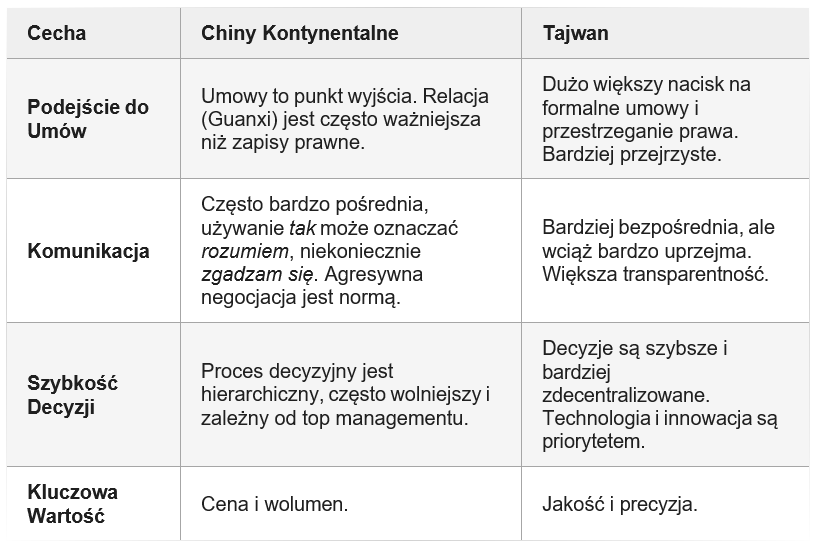
III. Business differences: mainland China vs Taiwan
Although Taiwanese businesspeople also value guanxi and mianzi, their business culture is often more organised, formal and closer to Western standards.
IV. How to negotiate effectively
- Patience: plan for a longer negotiation process. Haste will be seen as weakness.
- Hierarchy: always show respect to the most senior person in the room. Exchanging business cards should be ceremonial.
- A holistic vision: Chinese and Taiwanese partners value counterparts who look to the future and plan long-term cooperation — this builds guanxi.
- The role of an end-to-end partner: we act as a cultural bridge. Thanks to many years of experience in building relationships, we avoid typical cultural mistakes and efficiently lead the way to a favourable, lasting agreement.
Conclusion: importing from China and Taiwan is a marathon, not a sprint. Success requires not only knowledge of the market but above all respect for local etiquette. By entrusting this process to us, you gain a partner who moves fluently in the Asian business world.